
Skip to content
LatestFocus Graphite Commences Government-Supported Pilot-Scale Graphite Processing Program with COREM and Advances Lac Tétépisca PEA

Technology

Mining Technology. Processing Technology. Advanced Materials.

Silicone Enhanced Spheroidization of Graphene Particles

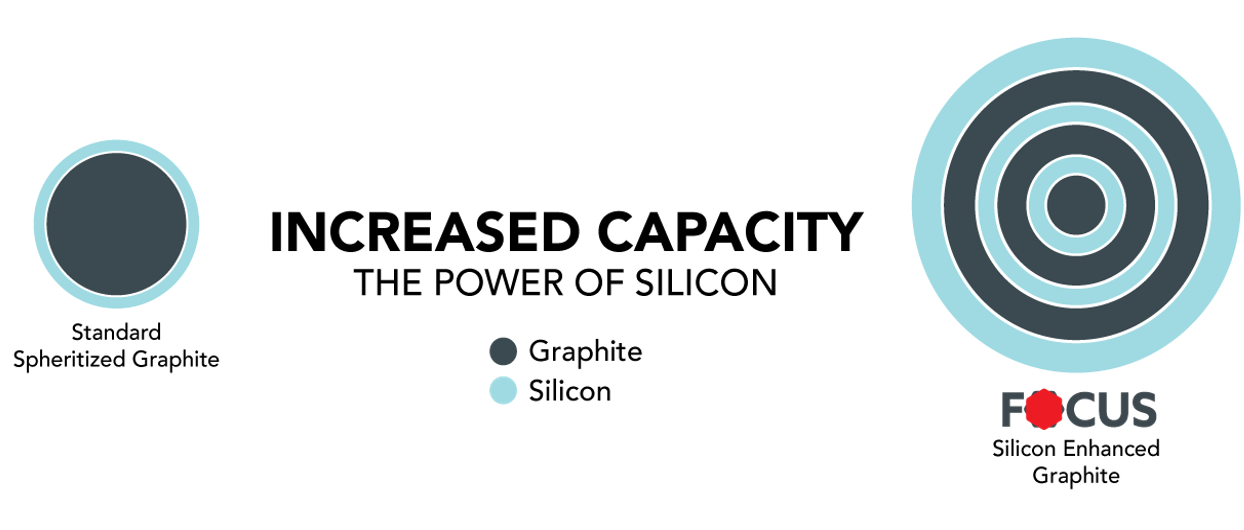
Focus Graphite Advanced Material's proprietary process incorporates multiple layers of silicon as the sphere is being created. This allows for significantly increased silicon content, which is crucial because silicon has 7 to 8 times the energy storage capacity of graphite.

This novel approach directly addresses two major challenges in silicon-enhanced anode materials:

Charge-induced volume expansion: Conventional single-layer silicon coatings tend to swell during charging, leading to structural instability. By embedding silicon within the graphite layers, Focus Graphite Advanced Material's technology mitigates this issue and provides superior mechanical integrity.

Unreliable solid electrolyte interphase (SEI) propagation: Silicon interacts with the electrolyte, causing performance degradation over time. The protective graphite layers in Focus Graphite Advanced Material's technology reduce these reactions, enhancing battery longevity and efficiency.Figure from Our Technology

Our anode technology is versatile and works with any type of graphite, enabling wide-scale adoption.

Green Anode Processing Technology

Figure from Our Technology

Eco-Friendly Purification Process

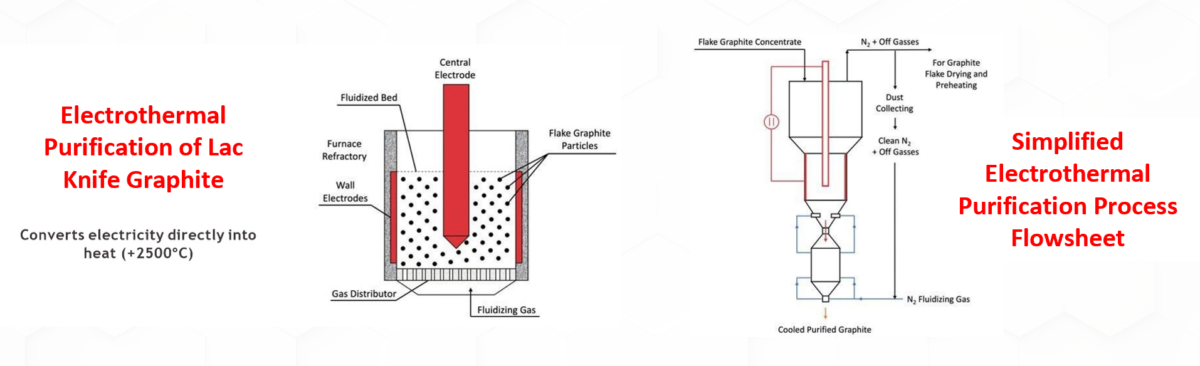
High heat removes impurities concentrated on the graphite's surface, optimizing yield and purity.

This step is made possible by Lac Knife's unique deposit, where impurities are located on the outside of the flake, allowing easy and efficient removal.

No harmful chemicals are used during processing.

In the end, the by-product is gypsum, repurposed for construction applications (e.g., drywall).

Alignment With Sustainability

Green processing technology aligns with Focus Graphite's commitment to reducing environmental impact while producing premium-quality graphite materials.

Focus Graphite is committed to the greenest, most sustainable mining and processing practices, continuously partnering with institutions and industry to drive innovation.

Flake Characterization Study

The flake characterization study employs cutting-edge imaging techniques to analyze the distribution, size, and purity of graphite flakes directly from drill core and to integrate such information into the resource model.

The study focuses on:

  • High-Resolution Optical Imaging and Image Processing: Core cuttings are mapped for in-situ distribution of jumbo, large, medium, and small graphite flakes to enable incorporation of estimated flake value in individual resource block models, informing selective mining strategies.
  • Advanced Analytical Tools: The study utilizes the ARTSection automated correlative microscopy platform developed by IOS Geosciences, integrating different types of images including circular polarization, phase contrast, and back-scattered electron images. These images are segmented using AI-based algorithms to individualize flakes and provide textural quantification through routine, low-cost analyses.
  • Flake Size Calibration: A series of grinding and beneficiation tests are being conducted. Concentrates will be analyzed for Carbon Content and Purity through Thermogravimetric Analysis (TGA) to refine downstream processing approaches.
  • Environmental Characterization: The study will identify the abundance and textures of environmentally deleterious minerals, and tests will be conducted for sulfide recovery. By targeting high-purity zones and avoiding unnecessary disruption of non-graphitic material, the company aims to reduce waste and minimize its environmental footprint.
  • Pilot-Scale Testing: Preliminary extractions will validate the feasibility of processing high-purity graphite at an industrial scale, ensuring optimized yield and efficiency.

Strategic & Environmental Benefits of the Study

  • Improve the accuracy of the block model, enabling lower cut-off grades.
  • Enhance efficiency of graphite extraction and processing, reducing operational costs and environmental impact.
  • Strengthen Focus Graphite Advanced Materials' position as a provider of premium, high-grade graphite tailored for niche applications such as energy storage, aerospace, and defense.
  • Support sustainable resource development and responsible stewardship of high-purity flake graphite.
  • Demonstrate the Company's commitment to technological advancements in mineral exploration and processing.

Focus Graphite is committed to the greenest, most sustainable mining and processing practices, continuously partnering with institutions and industry to drive innovation.

Research and Development

Research and Development

Our expert, Dr. Joseph E. Doninger, MSc, BSc, is Focus Graphite's Director of Manufacturing and Technology. Dr. Doninger is an internationally recognized graphite processing expert and an inventor of 6 patents and an author of over 29 technical papers and presentations related to graphite and minerals processing and the use of graphite in energy storage systems.

Since joining Focus Graphite in 2012, Dr. Doninger's work has been integral to the company's research and development program. His work explores ways to optimize the suitability of the high-quality flake graphite found at Focus' properties for various battery and energy storage applications.

To read details of Dr. Doninger's publications and technical presentations, please click on the links below.

Processing and Performance of Lac Knife Natural Crystalline Flake Graphite From Quebec, Canada

2023 CIM Conference - Montreal, QC - May 3rd, 2023

The presentation covers the results of the 2014 Lac Knife pilot plant flotation tests which produced high purity flake graphite with a graphitic carbon content of up to 98.3%, and outlines that further electrothermal purification steps performed on the Lac Knife graphite concentrate allowed for the recovery of a portion of the graphite concentrate with a graphitic carbon content of more than 99.98% making it suitable for high-performance applications potentially beyond its general intended use as battery grade graphite. The purified Lac Knife graphite demonstrated increased electrical conductivity, increased first cycle capacity, and decreased irreversible capacity loss when compared to regular natural flake graphite and synthetic graphite.

Electrochemical Performance of Silicon Enhanced Lac Knife Natural Flake Graphite in Lithium-Ion Batteries

Military Power Sources Consortium Silicon Anode Seminar - Aberdeen Proving Ground, MD - March 7-8, 2023

The process developed for the production of Silicon Enhanced coated spherical graphite (SPG) involves adding the silicon to the purified Lac Knife flake graphite in an oxygen free atmosphere prior to spheroidization and before coating the SPG with carbon. Three grades of carbon coated SPG were developed for the anodes of Lithium-Ion batteries, ranging from the standard (D50 = 23.9um) grade to the fine (D50 = 17.4um) and ultra-fine (D50 = ll.9um) grades of SPG. Initial long term cycling tests showed that the coin cells made with the high purity fine grade of Lac Knife flake graphite exhibited almost zero loss in capacity after the first 110 cycles when compared with two commercial grades of natural flake graphite tested which had capacity losses of 4% and 6%. A PCT patent application on the process used to produce the Carbon Coated Silicon Enhanced Spherical
Graphite is currently under review by the Patent Office.

Cycling Characteristics of Silicon Enhanced and Boronated Lac Knife Natural Flake Graphite From Quebec, Canada in Lithium Ion Batteries

36th International Battery Seminar - Fort Lauderdale, FL - March 26, 2019

The first half of this presentation covers the development of the different grades of Lac Knife flotation, purified and spherical graphites and reviewed the results of coin cell tests which showed that the Lac Knife graphite outperformed synthetic graphite over a wide range of cycle times in Li Ion battery formulations. Additional coin cell data is presented that shows that the silicon enhanced Lac Knife graphite Lithium Ion battery formulations exhibited highly stable cycling performance. The initial work conducted on treating the Lac Knife graphite with boron is very encouraging and showed excellent potential for the use of boronated graphite in high rate applications.

Electrochemical Performance of Silicon Enhanced Lac Knife Natural Flake Graphite From Quebec, Canada in Lithium Ion Batteries

35th International Battery Seminar, Fort Lauderdale FL - March 26, 2018

This presentation includes coin cell tests that were conducted on Lac Knife carbon coated spherical graphite treated with amorphous silicon at levels ranging from 4.5 to 18 wt% Si. The results showed that the reversible capacities achieved in the anode with the silicon enhanced graphite ranged from 462 to 613 mAh/g well beyond graphite's theoretical limit of 372 mAh/g.

Electrochemical Performance of Lac Knife Graphite and Initial Results on Silicon Enhanced Graphite for Lithium Ion Batteries

Electrical Vehicle Symposium and Exhibition (EVS 30), Stuttgart, Germany - October 9, 2017

This technical paper, which was published in the EVS 30 proceedings, summarizes the electrochemical performance achieved previously on the Lac Knife natural crystalline flake graphite along with the initial results on the testing of the Lac Knife silicon enhanced graphite in lithium Ion coin cells. The data show that, at an addition level of 4.5% silicon, the application of a carbon coating to the Lac Knife spherical graphite resulted in an increase in the reversible capacity to 460 Ah/kg (See Figure 12) which is 24% higher than the theoretical capacity of 372 Ah/kg for graphite alone.as compared with a reversible capacity of 392 Ah/kg for the uncoated version (See Figure 11). Although coin cell tests at the 18% silicon addition level were only run on the uncoated version of the spherical graphite, the reversible capacity did reach 612 Ah/kg (See Figure 13) which is almost double the capacity that can be achieved with commercially available grades of synthetic and flake graphites. As noted previously, applying a carbon coating to this grade will increase the reversible capacity of the 18% silicon enhanced Lac Knife graphite even further.

Advances in the Performance of Lac Knife Natural Flake and Expanded Graphite in Electrochemical Power Sources

34th International Battery Seminar, Fort Lauderdale FL - March 20, 2017

This presentation introduces the development of a new Superfine grade of coated spherical flake graphite for high power applications that has a d50 of 11.9 microns compared with d50s of 17.4 and 23.9 microns for the Fine and Standard grades (See Figure 2 and Table 1), It also highlights the extended long term cycling performance of the Lac Knife graphite where the coin cells made with the Lac Knife flake graphite lasted about 560 cycles and only lost about 4.5% of its capacity before the end of the test compared with the performance of two commercial grades of flake graphite which had capacity losses of 10.5% and 11.7% and didn't last as long (See Figure 4). Additional conductivity enhancement data on two new grades (d50s of 21 and 3.5 microns) of expanded graphite are compared with the performance of commercial synthetic and expanded flake graphite in Lithium Ion (See Figure 5) and Alkaline (See Figure 7) batteries.

Electrochemical Performance of Lac Knife High Purity Flake in the Anode and Cathode of Lithium Ion Batteries

16th Annual Advanced Automotive Battery Conference, Detroit, MI - June 14, 2016

This presentation includes coin cell data comparing the performance of the Lac Knife flake graphite with synthetic graphite at different charging rates and shows (See Fig. 8) that, at a C/2 charging rate, the capacity of the batteries made with the Lac Knife graphite (252 Ah/kg) was still 24% higher than what was achieved with synthetic graphite (204 Ah/kg) at the same rate. It also shows the importance of using high purity graphite to improve the long term cycling performance of Lithium Ion batteries (See Figure 13).

Long Term Cycling Performance and Conductivity Enhancement Characteristics of Lac Knife Flake Graphite From Quebec, Canada

33rd International Battery Seminar, Fort Lauderdale FL - March 21, 2016

This presentation shows that the reversible capacity of Lithium Ion batteries made with Lac Knife natural flake graphite is 6% higher than what was achieved with commercial synthetic graphite (See Table 1). Initial long-term cycling tests also show that the Lac Knife graphite exhibited almost zero loss in capacity after 110 cycles when the two commercial grades of natural flake graphite tested exhibited capacity losses of 4 to 6% (See Figure 7). It also includes the process used to produce expanded Lac Knife graphite which results in the manufacture of a high performance conductive graphite that is 5 to 6 times more conductive than standard flake and synthetic graphite in the cathode of Lithium Ion batteries at a 2% addition level (See Figure 10).

Electrochemical Performance of High Purity Graphite From the Lac Knife Graphite Deposit in Quebec, Canada

32nd international Battery Seminar, Fort Lauderdale FL - March 10, 2015

The first half of this presentation covers the history of the development of the Lac Knife graphite deposit, our exploration and drilling program, and our extensive flotation pilot plant testing program used to recover a 98.3% carbon flake graphite concentrate from the Lac Knife ore (See Slide 19).The second half of this presentation shows how the Lac Knife graphite was purified, spheroidized, carbon coated and classified to produce our standard and fine grades of Lithium Ion battery grade graphite and then tested in coin cells to obtain performance data (See Slide 25) which show that the Lac Knife battery grade graphite achieved nearly theoretical reversible capacities of 365 Ah/kg and irreversible capacity losses of 1.0% and 1.4%.

Subscribe for Updates

Receive Focus Graphite news releases and corporate updates by email as they are issued.